How Baccarat Works in a Casino: Third-Card Rules Explained
Baccarat’s fixed drawing rules decide every hand, from Player stands on 6–7 to Banker’s own table and naturals that end play early
· 3 min
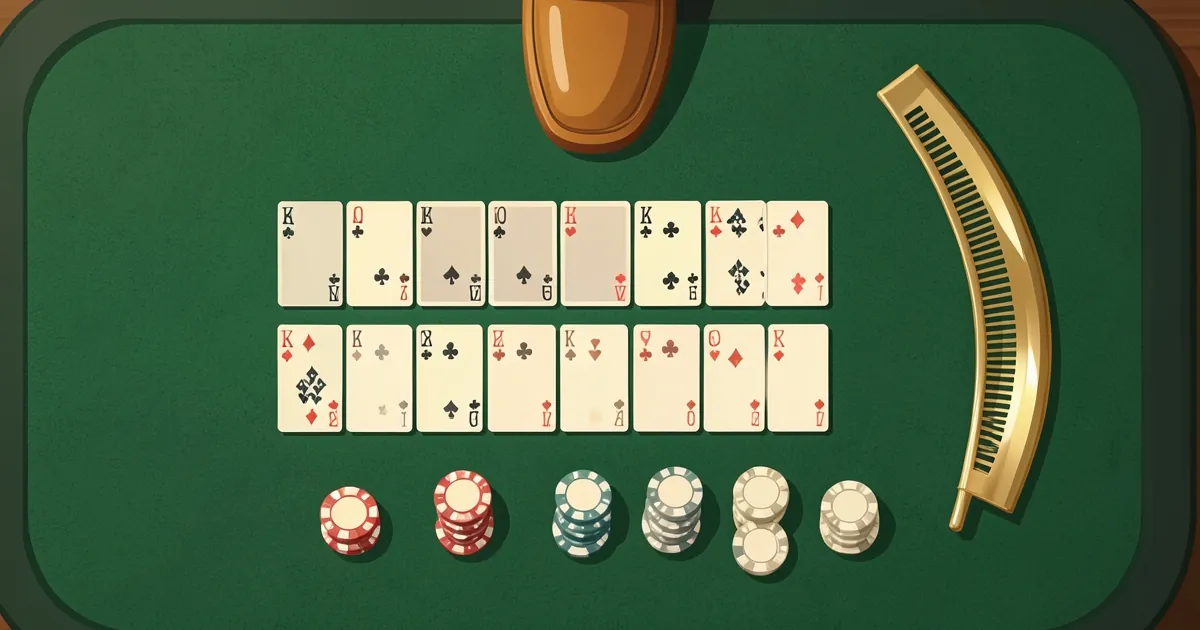
Baccarat looks like a coin flip with extra ceremony, but the outcome is decided by a fixed set of drawing rules that neither the dealer nor the player can override. The Player hand draws on 0–5 and stands on 6–7; the Banker hand then follows its own table, and a natural 8 or 9 ends the hand before anyone draws. Learn those two tables and the game stops being mysterious — the only decision left is which side to back and how much to pay for it.
The two-card deal and the naturals
Eight decks, shuffled and dealt from a shoe. Two cards to Player, two to Banker, face values summed and the tens digit dropped: 7 + 6 = 13, which counts as 3. Face cards and tens are worth zero, aces one.
If either hand totals 8 or 9 on the first two cards, that's a natural. Both hands stand, the higher total wins, and ties push. Roughly one hand in eleven is a tie, which is why the tie bet's house edge sits far above the other two — a point worth revisiting below.
When the Player hand draws
The Player side has no judgment call in it. Pennsylvania Gaming Control Board rules state it plainly: Player draws on 0 through 5, stands on 6 and 7.
That's the whole Player table. There is no "should I hit" moment, no count to track, no decision that a skilled player makes differently from a first-timer. It is a deterministic instruction executed by the dealer.
The Banker third-card table
The Banker hand is where people get lost, because its draw rule depends on whether Player drew at all.
If Player stood on 6 or 7, the Banker draws on 0 through 5 and stands on 6 through 9. Simple enough.
If Player drew a third card, the Banker's decision keys off its own two-card total and the value of the card Player just pulled. Per the Tulalip Resort rules sheet, the pattern runs like this:
- Banker 0–2: always draws.
- Banker 3: draws unless Player's third card is an 8.
- Banker 4: draws on 2–7, stands on 0, 1, 8, 9.
- Banker 5: draws on 4–7, stands otherwise.
- Banker 6: draws only on 6 or 7.
- Banker 7: stands.
The logic is asymmetric on purpose. It's tuned to make the Banker hand — which draws second, with more information — win slightly more often than it loses, which is why the Banker bet carries commission.
Why the Banker bet costs 5% and the tie costs more
Banker wins about 45.9% of hands against Player's 44.6%, so books take a 5% commission on Banker winnings to level the field. That leaves a house edge near 1.06% on Banker and 1.24% on Player — two of the thinnest margins on any casino floor.
The tie bet is the trap. It pays 8-to-1 and hits roughly 9.5% of the time, producing a house edge around 14.4%. If you're comparing it to other bets where the payout math looks better than it is, the same break-even logic that governs pot odds in poker applies here: a price that looks generous usually isn't.
Squeeze tables, where players peel cards slowly, don't change any of this — they change the pace. Slower hands mean more rounds per hour and more exposure to the house edge, and the ritual has its own cost, as we looked at in live dealer baccarat squeeze cards.
A game Nevada had to import
Baccarat isn't native to the American casino. When Nevada legalized gambling with Assembly Bill 98 in 1931, baccarat wasn't on the list of permitted games. The modern version arrived via Tommy Renzoni, who brought Punto Banco from post-Castro Cuba by way of Argentina and opened the first table at the Las Vegas Sands on November 20, 1959, according to UNLV research.
The import worked. Baccarat generated $1.49 billion of Nevada's table, counter and card game revenue in 2023, up 28.2% year on year — a game with no strategy decisions outselling most games that have them.
That's the oddity worth sitting with. Baccarat offers players exactly one meaningful choice, and the mathematically correct answer — Banker, flat-bet, no tie — is also the least interesting one to watch. Whether a game can keep growing on revenue like that while asking almost nothing of the people playing it is a question the next few years of Nevada's monthly reports will answer.