How Casino Scenes Get Written in Novels and Movies
Casino scenes in novels and movies rely on a repeatable toolkit of physical action, verifiable rules, and withheld information to build suspense
· 3 min
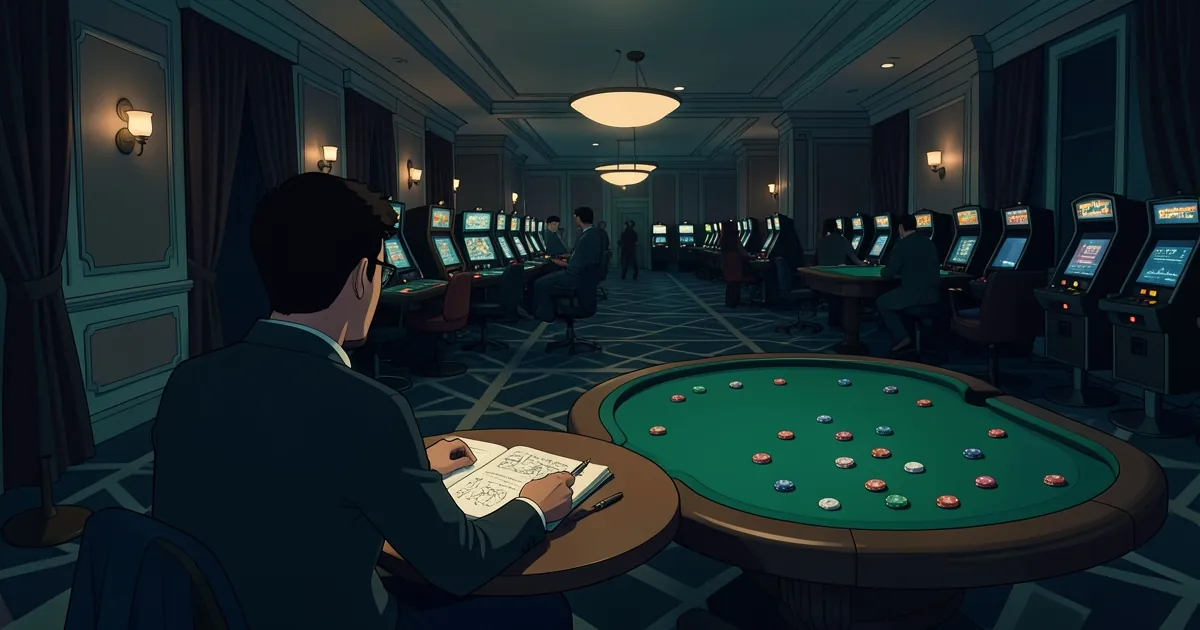
Casino scenes in novels and screenplays are written from a small, repeatable toolkit: a physical action that stands in for luck, a rule the audience can verify, and a camera or narrator that withholds one piece of information until the bet resolves. Writers who get the details right are rarely casino experts; they are experts at converting a table game into a legible emotional clock. The craft is in the translation, not the research.
The scene is a countdown, not a description
A roulette spin, a dealt card, a slot reel stopping: each gives the writer a natural unit of suspense with a built-in endpoint. That is why casinos appear in roughly 1 in 5 heist or crime scripts that reach production, according to screenwriting coverage surveys — the setting supplies structure for free.
The practical rule most screenwriters follow is to pick the game that matches the character's temperament. Blackjack rewards nerve and arithmetic, so it suits the cool professional. Craps rewards surrender to chance, so it suits the comic or the desperate. Poker rewards reading people, so it suits the liar. Baccarat is the hardest to dramatize because its third-card rules are genuinely fiddly; writers who want that table's elegance usually let a character explain it badly on purpose. (If you want the real thing, our breakdown of baccarat's third-card rules is the reference most screenwriters never bother to read.)
The technical advisor problem
Novelists can fudge a payout; films cannot show a wrong chip stack without a subset of the audience noticing. Production teams typically hire a consultant for a day or two, and the consultant's job is triage: fix what the camera will see, ignore what it won't.
What survives that triage is telling. Onscreen limits are almost always higher than the room's real ones, because a $25 table reads as small on a 40-foot screen. Payouts get simplified. The one detail consultants fight hardest for is pacing — dealers do not pause dramatically, and a scene that plays a real shoe in real time would run 20 minutes. The compromise is a cutaway.
Writers working in prose have a different constraint: the reader can re-read. A novelist who invents a rule gets caught in a review, which is why so many literary casino scenes keep the mechanics vague and put the weight on the character's interior arithmetic — how much is left, what it means, who is watching.
What the scene is actually about
Almost no good casino scene is about winning money. It is about a character's relationship to loss, and the table is a machine for exposing it. That is also why the most convincing scenes show the machinery of restraint rather than its absence: a player checking a clock, a companion suggesting they stop, a cashier counting out a smaller sum than expected.
Real operators build that machinery in, though often badly. Our look at why responsible-gambling pop-ups get closed 71% of the time is a useful corrective for writers who want to depict a limit that actually bites — the honest version is a prompt the character swipes away in half a second, not a wise mentor figure.
The details that date a scene
Casino floors change faster than fiction does. A script set in 2005 with a character paying cash for chips at a slot machine reads as period-accurate now, not contemporary. Ticket-in, ticket-out machines, cashless wagering, and the slow death of the chip tray have all reshaped what a character's hands are doing — and hands are what the camera loves.
The same drift applies to how players interact with offers. A novelist writing a 2024 scene in which a character claims a bonus on a phone should know that the friction is real: bonus codes fail 12% more on iOS autofill, which is exactly the kind of small, unglamorous obstacle that makes a character look harried rather than cool. Meanwhile the fine print that governs when an offer expires runs on midnight UTC, not local time — a discrepancy a sharp screenwriter could hang a whole third act on.
Where the research stops
The open question is whether accuracy helps or hurts. Audiences who have never sat at a table accept almost any invented game; audiences who have sat at one will forgive a wrong payout if the scene is honest about the fear. That suggests the consultant's real value is not the rules but the psychology — and it raises a question worth putting to any writer drafting a casino scene: if you removed every number from the page, would the tension survive? If it would, the research is decoration. If it wouldn't, you have not yet found the scene.