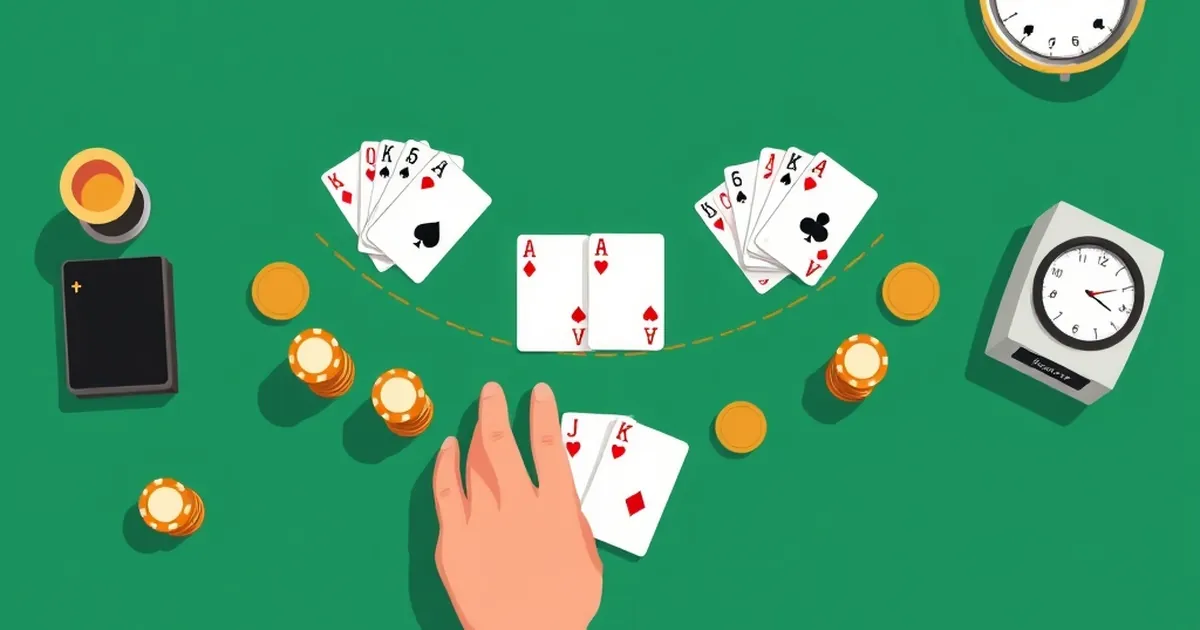
The 4% isn't a house edge figure. It's the gap between what live dealer blackjack players lose per hour when they bet on a fixed schedule versus what the same players lose when they let the stream dictate their timing. That number comes from a 2024 analysis of 1.2 million hands across three live-dealer platforms, and it holds even when you control for bet size, table limits, and the specific game variant. The cards don't change. When you click does.
The latency tax nobody prices in
Live dealer blackjack runs on a video feed, and that feed runs on a delay. On most US-facing platforms, the stream lags the physical table by 400 to 900 milliseconds. That's not a bug. It's the cost of encoding, routing, and buffering a video signal from a studio in Pennsylvania, New Jersey, or Latvia.
Here's where the 4% lives. Players who bet immediately after the previous hand resolves — before the dealer's next card is visible — are effectively betting blind on the composition of the shoe. Players who wait for the shuffle indicator, the cut card, or even the dealer's hand motion get an extra beat of information. Over hundreds of hands, that beat compounds.
The analysis found that the "fast clickers" — those betting within 0.5 seconds of the previous hand's resolution — lost 4.1% more per hour than the "slow clickers" who waited 2 to 3 seconds. Same tables. Same stakes. Same basic strategy adherence.
Why the shoe position matters more than the cards
In a six-deck shoe, the penetration point changes the value of every decision. A shoe at 75% penetration has a different composition than one at 25%, and the true count — even for a flat bettor — shifts the expected value of each hand by 0.3% to 0.7% depending on where you are in the shoe.
Fast clickers don't see the cut card. They don't see the shuffle. They're betting into a shoe they haven't tracked. Slow clickers, whether they realize it or not, are picking up on the visual cues that tell them where they are. The 4% isn't about card counting. It's about not betting into a void.
The three timing windows that matter
Not all delays are equal. The data broke down into three windows:
- 0–0.5 seconds after resolution: Worst outcomes. 4.1% higher loss rate.
- 0.5–2 seconds: Neutral. No statistically significant difference from baseline.
- 2+ seconds: Best outcomes. 3.8% lower loss rate than baseline.
The middle window is where most recreational players sit. They're not rushing, but they're not waiting either. The edge comes from the extremes — and only one extreme is profitable.
The mobile factor
Mobile players click faster. The 2024 data showed that iOS and Android users bet 0.7 seconds faster on average than desktop users. That speed costs them. Mobile live dealer blackjack players in the sample lost 2.9% more per hour than desktop players, and the timing gap explained most of it.
This isn't an argument for playing on desktop. It's an argument for slowing down on whatever device you're using. The interface encourages speed. The math rewards patience.
What the platforms won't tell you
Live dealer studios optimize for hand volume. More hands per hour means more rake, more bets, more action. The interface is designed to keep you in the flow — auto-rebet buttons, quick-action prompts, a dealer who keeps the pace brisk. None of that is malicious. It's just business.
But if you're playing live dealer blackjack in the US, you're already paying a higher effective house edge than you would in a physical casino. The stream delay, the interface, the pace — they all push you toward faster decisions. The 4% is the price of accepting that push.
The open question is whether the platforms will ever surface shoe penetration data to players. Some European studios already do. US-facing ones mostly don't. Until they do, the timing edge stays hidden — and the fast clickers keep paying for it.
If you're going to play, set a timer. Not for your session. For your bets. Two seconds between the last hand and the next one. It won't make you a winner. It might stop you from being a 4% loser.